
If your dog may have eaten grapes or raisins, contact your veterinarian or a pet poison service now. Do not wait for symptoms or finish these calculations before calling. This tool only helps describe the estimated exposure; no calculated amount proves safety.
Advanced options
How to use our Dog Raisin Toxicity Calculator
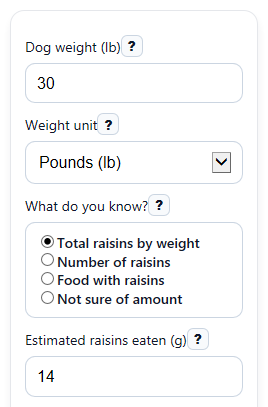
- Enter Dog weight, choose the Weight unit, and pick What do you know? based on the easiest way to describe what was eaten.
- If you know the amount by weight, fill in Estimated raisins eaten. If you counted raisins, enter Number of raisins eaten. If it was a mixed food, open Advanced options and enter Food with raisins, Amount of that food eaten, and Estimated raisins per serving.
- Choose Time since eating raisins, then click Calculate.
- Read What to do now first. If a number appears for Estimated raisin exposure, use it as an estimate only, then check Estimate confidence to see how rough that estimate is.
- Sanity-check the result by asking whether the Estimated total raisins eaten matches what your dog could realistically have eaten. If the amount is uncertain, switch to Not sure of amount and follow the urgent action message.
Definitions
Dog weight: Your dog's body weight, used to convert the exposure into grams of raisins per kilogram of body weight.
Weight unit: Whether the weight you entered is in pounds or kilograms.
Estimated raisins eaten: The total raisin amount in grams when you know the weight directly.
Number of raisins eaten: A raisin count used to estimate total grams when you do not know the weight.
Average weight per raisin: The estimated grams for one raisin. The default is a practical estimate, but raisin size can vary.
Estimated raisins per serving: How many grams of raisins are in one serving of a mixed food, such as cereal or raisin bread.
Estimated total raisins eaten: The calculator's best estimate of the total raisin amount involved, shown in grams.
Estimated raisin exposure: The estimated total raisin grams divided by your dog's weight in kilograms, shown as g/kg.
Kidney injury: Damage to the kidneys, which are organs that help filter waste and balance fluids in the body.
Common mistakes and quick fixes
Mistake: Leaving Dog weight at 30 when your dog weighs much less or much more.
Fix: Enter your dog's actual weight and confirm the right Weight unit before you calculate.
Mistake: Using Estimated raisins eaten for a count of loose raisins.
Fix: Switch What do you know? to the count option and enter Number of raisins eaten . If raisin size looks unusual, also adjust Average weight per raisin .
Mistake: Entering a mixed food amount but forgetting Estimated raisins per serving .
Fix: In the food mode, enter both Amount of that food eaten and Estimated raisins per serving , because the calculator needs both to estimate total raisin grams.
Mistake: Treating a lower Estimated raisin exposure as proof your dog is safe.
Fix: Read Important limit and What to do now carefully. The number is a conversion helper, not a safe cutoff.
Mistake: Guessing the timing and choosing the calmest option in Time since eating raisins .
Fix: If you do not know when it happened, choose the unsure option so the urgency message does not assume the safest timing.
Mistake: Entering 0 in Estimated raisins eaten or Number of raisins eaten even though you are not sure what was eaten.
Fix: Use What do you know? = Not sure of amount when the amount is unknown, then follow What to do now .
Limitations & Key Assumptions / Boundary Conditions
- This tool estimates exposure math only. It cannot tell you that any amount is safe.
- Grape and raisin toxicity in dogs can be unpredictable, so a lower g/kg estimate does not rule out danger [1][2].
- If you use Number of raisins eaten, the result depends on Average weight per raisin, and real raisins vary in size.
- If you use a mixed food estimate, the result depends on Amount of that food eaten and Estimated raisins per serving. Package serving sizes and homemade foods can differ a lot.
- Not sure of amount does not produce a numeric exposure because there is not enough information for a trustworthy calculation.
- Time since eating raisins helps with urgency wording, but exact treatment decisions still depend on your veterinarian or pet poison service.
- Symptoms may not be present right away, so waiting for signs is not a reliable way to judge safety [1][2].
Methodology
How the calculator works
The calculator first converts your dog's weight to kilograms. Then it estimates total raisin grams from the amount, count, or food estimate you entered. Last, it divides total raisin grams by dog weight in kilograms to show Estimated raisin exposure in g/kg.
dog_kg = dog_weight_lb x 0.45359237
dog_kg = dog_weight_kg
estimated_total_raisin_g = raisin_count x grams_per_raisin
estimated_total_raisin_g = servings_eaten x raisin_per_serving
estimated_exposure_g_per_kg = estimated_total_raisin_g / dog_kg
Worked mini-example
Suppose your dog weighs 30 lb and you know it ate 14 g of raisins. The calculator converts 30 lb to 13.6078 kg. Then it divides 14 g by 13.6078 kg, which gives about 1.0287 g/kg. That number is shown as the estimated exposure, but the action message still tells you to contact a veterinarian or pet poison service right away because raisin toxicity is not predictable [1][2].
How each entry mode is handled
If you choose Total raisins by weight, the calculator uses Estimated raisins eaten as the total grams.
If you choose Number of raisins, it multiplies Number of raisins eaten by Average weight per raisin. The default per-raisin weight is an editable estimate, not a fixed fact.
If you choose Food with raisins, it multiplies Amount of that food eaten by Estimated raisins per serving. This is useful when the dog ate cereal, bread, trail mix, or another mixed food.
If you choose Not sure of amount, the calculator does not show a numeric exposure because the amount is too uncertain. Instead, it shows an urgent action-first message.
How to interpret the results
Estimated total raisins eaten is a conversion helper. Estimated raisin exposure shows how much raisin may have been eaten for each kilogram of body weight. Higher numbers mean more estimated exposure, but there is no confirmed safe dose you can use to clear a dog at home [1][2].
What to do now is intentionally the main result. Early treatment may matter more than perfect dose math, especially when the exposure was recent.
Symptoms to watch for are supportive information only. They should not be used as a reason to delay getting help.
Assumptions used
The calculation assumes your entered weight is correct, the selected unit is correct, and any count-to-grams or food-to-grams estimate is reasonably close. If those inputs are off, the g/kg result will also be off.
The calculator also assumes that hidden fields from other entry modes are ignored, so only the currently relevant inputs affect the result.