
Enter your starting and target cell concentrations plus final volume to calculate the cell suspension and diluent volumes to mix.
Advanced options
Table of contents
How to use our Cell Dilution Calculator
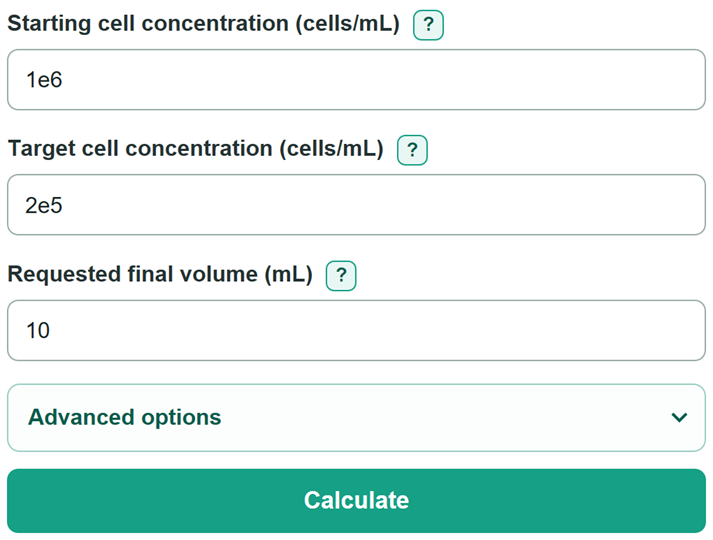
- Enter "Starting cell concentration (cells/mL)" from your count result after applying any dilution factor used for the counting sample.
- Enter the protocol values for "Target cell concentration (cells/mL)" and "Requested final volume (mL)." The requested volume is the total after cells and diluent are combined.
- Open "Advanced options" only if you need extra volume for transfer loss or want to enter your lowest reliable pipette transfer.
- Click "Calculate." Use "Starting cell suspension to use" and "Medium or diluent to add for the direct mix" if the direct transfer is practical.
- Check that the displayed stock and diluent volumes equal "Total suspension to prepare." If "Pipette plan" says the direct transfer is too small, follow the intermediate-mix volumes instead.
Definitions
Starting cell concentration: The measured concentration of the original cell suspension before dilution, in cells/mL.
Target cell concentration: The concentration required in the prepared suspension, in cells/mL.
Final volume: The total volume after cell suspension and diluent are combined.
Diluent: The medium or other liquid added to lower the cell concentration.
Extra preparation: An optional percentage added for transfer loss or dead volume. It increases the amount prepared while keeping the target concentration the same.
Dilution factor: Starting concentration divided by target concentration. A factor of 5 means the target concentration is one-fifth of the starting concentration.
Intermediate dilution: A separately mixed suspension used when the direct stock transfer is too small for a reliable pipette transfer.
Common mistakes and quick fixes
Mistake: Entering a total cell count instead of cells per mL.
Fix: Divide the cell count by the volume of its suspension, then enter the concentration in cells/mL.
Mistake: Using a count from a diluted counting sample without correcting it.
Fix: Apply the counting-sample dilution factor before entering "Starting cell concentration (cells/mL)."
Mistake: Treating requested final volume as the amount of medium to add.
Fix: Enter the total volume after the starting suspension and diluent are combined.
Mistake: Using viable-cell concentration for one field and total-cell concentration for the other.
Fix: Use the same counting basis in both concentration fields, following the protocol.
Mistake: Setting a target concentration higher than the starting suspension.
Fix: Use a more concentrated starting suspension or prepare the cells by a method other than dilution.
Mistake: Pipetting a calculated stock volume that is below the reliable range of the pipette.
Fix: Enter "Minimum reliable pipette volume (uL)" to get an intermediate-dilution plan when needed.
Limitations & Key Assumptions / Boundary Conditions
- The starting and target concentrations must use the same counting basis, such as viable cells/mL for both fields.
- The calculation assumes the suspension is mixed evenly before every measured transfer.
- Dilution can lower concentration but cannot produce a target concentration above the starting concentration.
- If the target concentration is zero, the calculation uses zero starting suspension and all diluent; the dilution factor is undefined and is not shown.
- The intermediate plan uses the entered minimum reliable pipette volume for both cell-containing transfers and does not replace local pipette-use procedures.
- The calculation does not account for settling, clumping, viability changes, evaporation, or losses after preparation.
Methodology
Direct dilution calculation
The calculator uses the concentration-volume relationship. C1 is the starting concentration, V1 is the volume of starting suspension, C2 is the target concentration, and V2 is the total volume prepared.
C1 x V1 = C2 x V2
It solves for the needed starting-suspension volume, then subtracts that volume from the prepared total to find the diluent volume.
V1 = (C2 x V2) / C1
Extra preparation, if entered, increases the total amount prepared before the direct-dilution calculation.
prepared total (mL) = requested final volume x (1 + extra preparation / 100)
The calculator converts mL to uL by multiplying by 1,000. It uses unrounded values for later steps and formats values only for display.
Worked example
With a starting concentration of 1,000,000 cells/mL, a target of 200,000 cells/mL, and a requested final volume of 10 mL with no extra preparation, use 2 mL of starting suspension and 8 mL of diluent. In uL, that is 2,000 uL of starting suspension plus 8,000 uL of diluent.
V1 = (200,000 cells/mL x 10 mL) / 1,000,000 cells/mL = 2 mL
Small-transfer plan
If a positive "Minimum reliable pipette volume (uL)" is entered and the direct stock transfer is smaller than that minimum, the calculator provides an intermediate dilution. It sets the original-stock transfer and the intermediate-to-final transfer to the entered minimum, then calculates the intermediate concentration and the diluent needed at each step.
intermediate concentration = target concentration x prepared total volume / intermediate transfer volume