
Enter two comparable population readings and the time between them to calculate the estimated time for one microbial population doubling.
Table of contents
How to use our Generation Time Calculator
- Choose the measurement type used for both population readings, such as CFU/mL, cells/mL, total cells, or OD600.
- Enter the earlier reading as the initial population and the later reading as the final population.
- Enter the time between readings and choose minutes or hours to match your lab record.
- Click Calculate, then check that the population increased and that both readings came from approximately exponential, or log-phase, growth before using the generation time.
Definitions
Generation time: The estimated time needed for a microbial population to double during exponential growth.
Initial population: The earlier population measurement.
Final population: The later population measurement using the same basis as the initial population.
Number of generations: The number of population doublings between the two readings. It may be a fraction.
Population increase factor: Final population divided by initial population. A factor of 8 means the final population is eight times the initial population.
CFU/mL: Colony-forming units per milliliter, a colony-based measurement from a sample.
OD600: Optical density measured at 600 nm. It may be used only as two comparable relative readings in this calculator; it is not converted to cells or CFU.
Exponential (log) phase: A period when a population grows by repeated proportional increases. This calculation assumes the readings come from this phase.
Common mistakes and quick fixes
Mistake: Using CFU/mL for one reading and total cells for the other.
Fix: Use the same measurement basis for both readings, or convert the source data before calculating.
Mistake: Expecting a generation time of zero when the two readings are equal.
Fix: Equal readings mean no doubling occurred. The generation time is undefined, not zero.
Mistake: Using a lower final population as though it shows growth.
Fix: A population decrease has no positive generation time under this growth model. Check the data or use a decline analysis.
Mistake: Entering hours while Minutes is selected.
Fix: Match the selected unit to the number entered. Changing the unit converts a valid entered duration.
Mistake: Using lag-phase, stationary-phase, or death-phase readings.
Fix: Use two comparable readings from approximately exponential, also called log-phase, growth.
Mistake: Typing an invalid grouped number such as 1,00.
Fix: Use a plain number, scientific notation such as 1e6, or standard grouping such as 1,000.
Limitations & Key Assumptions / Boundary Conditions
- The calculation assumes both readings are comparable and were collected during approximately exponential growth.
- It uses two measurements only, so an unusual reading or measurement error can strongly affect the estimate.
- The final population must exceed the initial population. Equal populations have no measurable doubling, and a decrease does not produce a positive generation time.
- CFU/mL, cells/mL, total cells, and OD600 cannot be mixed. OD600 is a relative reading and is not converted to a cell count.
- The answer uses the selected elapsed-time unit. Convert units before comparing results reported in minutes per generation and hours per generation.
Methodology
Calculation
The calculator first divides the final population by the initial population to find the population increase factor. Both values must be positive and use the same measurement basis.
population increase factor = final population / initial population
It converts that factor into the number of generations, where one generation means one doubling.
number of generations = ln(population increase factor) / ln(2)
It then divides the elapsed time by the number of generations.
generation time = elapsed time / number of generations
Worked example
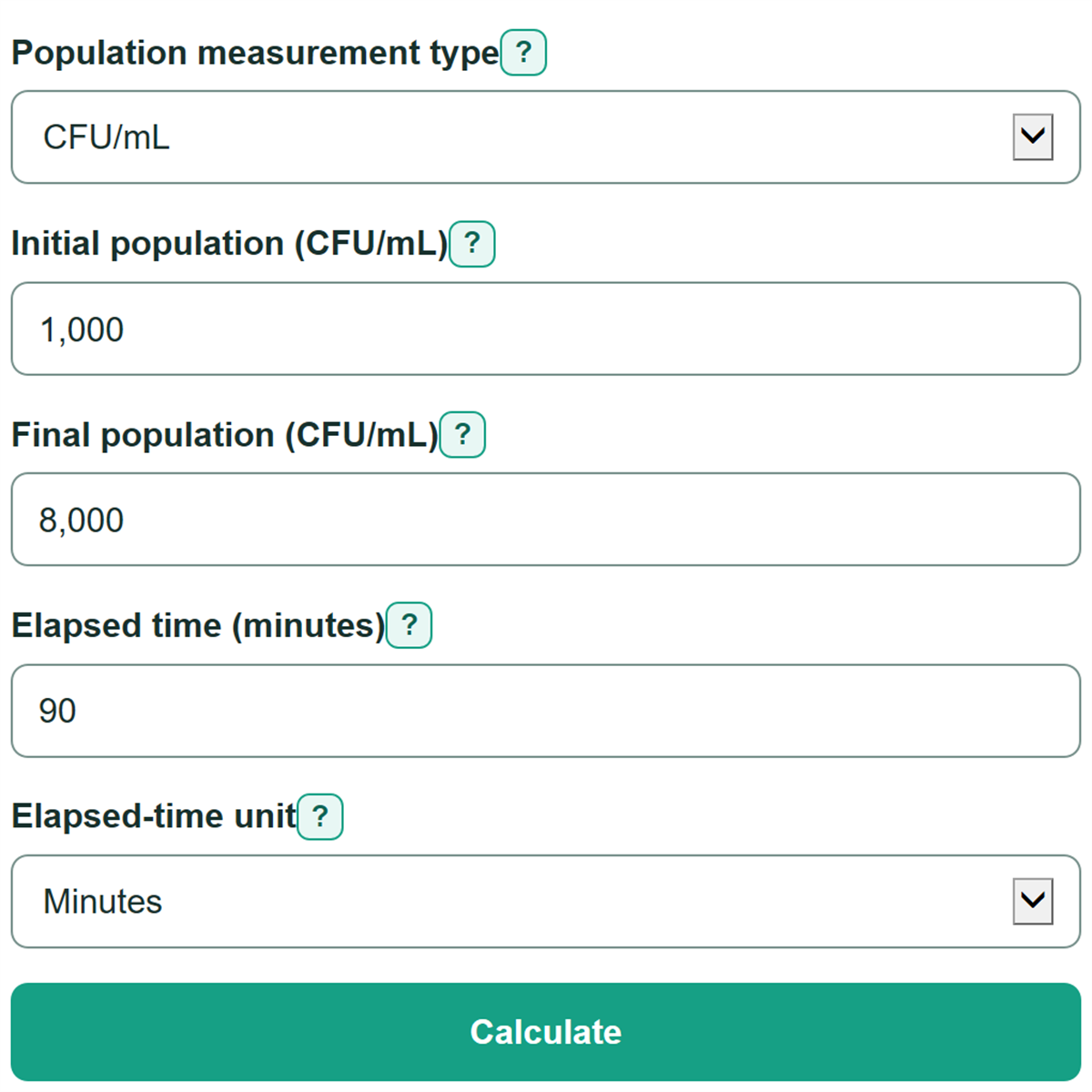
A culture changes from 1,000 CFU/mL to 8,000 CFU/mL in 90 minutes. The increase factor is 8, which equals 2 raised to the third power, so there are 3 generations. Dividing 90 minutes by 3 gives 30 minutes per generation.
Reading the result
Generation time is time per doubling. Keep the displayed time unit with the answer when comparing cultures or lab records. Growth rate uses a different convention from generation time. [1]