
Use this calculator to find horsepower, torque, or engine speed from the other two values with lb-ft or Nm units.
Advanced options
How to use our Engine Horsepower Calculator
- Pick Find to choose whether you want Calculated value to be horsepower, torque, or engine speed.
- Select the correct Torque unit, then enter the two visible inputs: Torque and Engine speed (RPM), Horsepower and Engine speed (RPM), or Horsepower and Torque.
- If you want cleaner display values, open the extra settings and choose Rounding (decimals) and Small-number display (significant digits), then click Calculate.
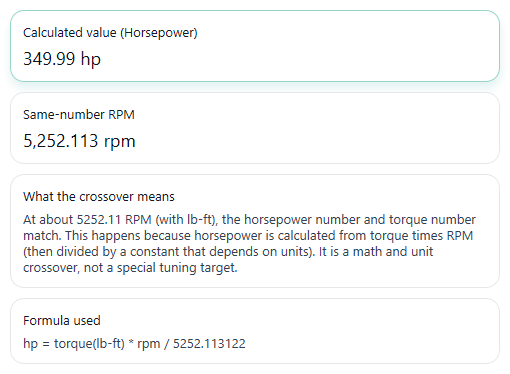
- Check Formula used and Same-number RPM to make sure the unit choice matches your source data; if your dyno sheet is in Nm but you picked lb-ft, the answer will be off.
- Read What the crossover means as a unit note, not a performance target: it tells you where horsepower and torque share the same number in the selected torque unit.
Definitions
Horsepower: A unit of power, which means how fast work is being done by the engine [1].
Torque: Twisting force. In this calculator, it can be entered in lb-ft or Nm.
Engine speed (RPM): Revolutions per minute, or how many full turns the engine makes each minute.
lb-ft: Pound-feet, a US torque unit commonly used on car spec sheets.
Nm: Newton-meters, a metric torque unit.
Same-number RPM: The RPM where horsepower and torque have the same numeric value in the selected torque unit. The RPM changes when the torque unit changes.
Rounding (decimals): How many digits to show after the decimal point in normal-sized results.
Small-number display (significant digits): How many meaningful digits to show when a result is very small.
Common mistakes and quick fixes
Mistake: Entering a Nm value in Torque while Torque unit is set to lb-ft.
Fix: Change Torque unit to match your source before you calculate, then recheck Calculated value and Formula used .
Mistake: Leaving Engine speed (RPM) at 0 when trying to find Horsepower or Torque .
Fix: Enter an RPM greater than 0. The formula divides by RPM when solving torque, and power needs engine speed to be meaningful.
Mistake: Using a negative value in Horsepower for a normal engine output check.
Fix: Enter a positive Horsepower value or 0 if you are testing a zero-output case. This page is set up for typical engine-output use.
Mistake: Typing the number you want to solve into the hidden or non-needed field, then expecting it to affect Calculated value .
Fix: Only the inputs required by Find are used. Enter the two known values that stay visible for that mode.
Mistake: Treating Same-number RPM as the best shift point or best tuning target.
Fix: Read What the crossover means . It is a math result caused by units, not a universal engine goal.
Mistake: Rounding your source numbers too hard before entering them, such as shortening dyno data a lot, then trusting the exact last digit of Calculated value .
Fix: Enter the most precise Torque , Engine speed (RPM) , or Horsepower values you have, then use Rounding (decimals) only for display.
Limitations & Key Assumptions / Boundary Conditions
- This calculator uses the standard power-torque-speed relationship only. It does not estimate wheel horsepower, crank losses, trap speed, or engine size.
- Results are only as good as the numbers you enter. Mixed units, rounded dyno data, or copied values from different test conditions can change the answer.
- When solving for horsepower or torque, Engine speed (RPM) must be greater than 0. When solving for engine speed, Torque must be greater than 0.
- Negative horsepower is blocked here because this page is aimed at normal engine output checks, not braking or absorption cases.
- The crossover note is a unit-based math fact. It does not tell you the best RPM for power, torque, shifting, or tuning.
- Displayed values are rounded for readability, but the calculator uses full-precision constants in the math.
Methodology
Core idea
Engine power is based on torque and angular speed. This calculator rearranges that relationship to solve for horsepower, torque, or RPM, depending on which value you choose to find [2].
Constants used
For lb-ft: constant = 5252.113122
For Nm: constant = 7120.909237
These constants change because the torque unit changes. Horsepower is a power unit [1], and torque is a twisting quantity measured in units such as pound-feet or newton-meters [3].
Formulas
hp = torque_lbft x rpm / 5252.113122
hp = torque_nm x rpm / 7120.909237
torque_lbft = hp x 5252.113122 / rpm
torque_nm = hp x 7120.909237 / rpm
rpm = hp x 5252.113122 / torque_lbft
rpm = hp x 7120.909237 / torque_nm
Worked mini-example
If Find is set to horsepower, Torque unit is lb-ft, Torque is 300, and Engine speed (RPM) is 5252, then the calculator does this:
hp = 300 x 5252 / 5252.113122
hp = 299.9935...
Displayed with normal rounding, that is 300 hp.
Same-number RPM
The calculator also shows the RPM where horsepower and torque have the same numeric value for the selected torque unit. In lb-ft, that happens at 5252.113122 RPM. In Nm, it happens at 7120.909237 RPM. This is a unit-based crossover, not a special engine tuning target.
Validation and display rules
Only the inputs needed for the selected mode are used. Hidden inputs are ignored. RPM must be above 0 when it is used as a divisor, torque must be above 0 when solving RPM, and negative horsepower is rejected for this engine-output page.
Assumptions
This tool assumes steady values entered in matching units and uses mechanical horsepower. Real dyno results can differ because of measurement method, correction factors, drivetrain losses, and rounding in the source data.