
Use this TDEE calculator to estimate your maintenance calories, resting calories, and a practical daily calorie target for your goal.
Advanced options
How to use our TDEE Calculator
- Choose your Sex used in formula, enter Age (years), pick Input units, and then fill in the matching height and weight fields only.
- Choose Activity input method. Use Standard activity level if you already know your category, or Guided estimate if you want help choosing a multiplier from your usual steps and exercise days.
- Select your Goal. If you choose lose or gain, open Advanced options and set Target rate (lb/week). If you want the alternate resting-calorie equation, also choose BMR formula there.
- Click Calculate and read Estimated maintenance calories first, then Daily calorie target for your goal. Sanity-check the result by asking whether the number fits your real routine; if your activity setting seems too high or too low, change it and compare.
- Use the result as a starting target for 2 to 4 weeks, then adjust based on your real weight trend, appetite, training, and consistency.
Definitions
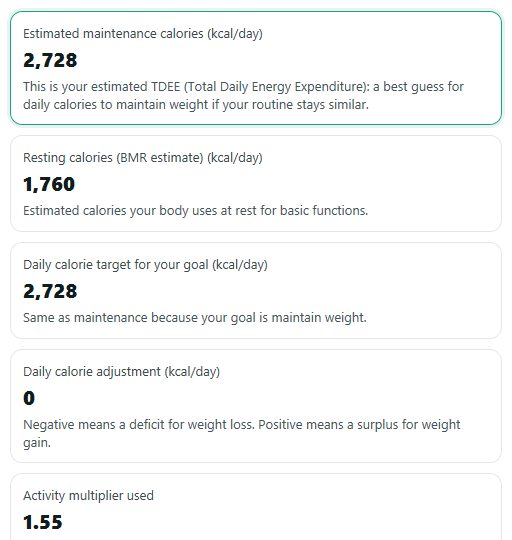
Estimated maintenance calories: Your estimated daily calories to maintain your current weight if your routine stays similar.
Daily calorie target for your goal: Your maintenance estimate adjusted for maintaining, losing, or gaining weight.
Resting calories (BMR estimate): Calories your body would use at rest for basic functions like breathing and circulation.
Activity multiplier used: The number multiplied by resting calories to estimate your full daily energy use.
BMR formula: The equation used to estimate resting calories. This calculator uses either Mifflin-St Jeor or Katch-McArdle.
Body fat (%): The percent of your body weight that is fat. It is only used for the Katch-McArdle option.
Daily calorie adjustment: The calories added above maintenance for gain or subtracted below maintenance for loss.
Common mistakes and quick fixes
Mistake: Entering both US and metric body measurements, then expecting both to be used.
Fix: Pick one Input units option and fill only the active fields: either Height (feet) , Height (inches) , and Weight (lb) , or Height (cm) and Weight (kg) .
Mistake: Putting total inches into Height (inches) , such as entering 70 instead of 5 feet 10 inches.
Fix: Enter whole feet in Height (feet) and only the leftover inches from 0 to 11 in Height (inches) .
Mistake: Choosing a high Activity level based on one hard workout instead of your usual week.
Fix: Base the choice on your typical routine, or switch Activity input method to guided and use Typical daily steps plus Purposeful exercise (days/week) .
Mistake: Selecting Katch-McArdle without a reasonable Body fat (%) estimate.
Fix: If you do not know body fat fairly well, keep BMR formula on Mifflin-St Jeor so your Resting calories (BMR estimate) is based on the standard height, weight, age, and sex inputs.
Mistake: Forgetting to set Target rate (lb/week) when your Goal is lose or gain.
Fix: Open Advanced options and choose a weekly pace so the Daily calorie adjustment and Daily calorie target for your goal match your plan.
Mistake: Treating Estimated maintenance calories as an exact personal truth from day one.
Fix: Use it as a starting estimate, then compare it with your real weight trend for 2 to 4 weeks and adjust if needed.
Limitations & Key Assumptions / Boundary Conditions
- This calculator gives an estimate, not a direct measurement of your true daily calorie needs.
- The result depends heavily on your chosen activity setting. A too-high or too-low activity choice can shift the calorie target a lot.
- Mifflin-St Jeor uses sex, age, height, and weight. Katch-McArdle also depends on Body fat (%), so a poor body-fat estimate can make that result less accurate.
- The lose or gain target uses a simple planning rule of 3,500 kcal per lb, which is useful for rough planning but does not capture all real body changes over time.
- Daily energy needs can change with training volume, non-exercise movement, sleep, stress, illness, medications, and menstrual cycle effects.
- If your calculated Daily calorie target for your goal is very low, the math is still shown, but a safer plan may need medical or dietitian guidance.
- This tool is designed for adults using the provided formula choices and may not fit every special case or clinical situation.
Methodology
How the calculator works
The calculator first estimates Resting calories (BMR estimate), then multiplies that by an activity factor to get Estimated maintenance calories. After that, it adjusts the maintenance number up, down, or not at all based on your selected Goal.
Step 1: Convert units when needed
If you use US inputs, weight is converted from pounds to kilograms and height is converted from feet and inches to centimeters.
weight_kg = weight_lb * 0.45359237
height_cm = ((height_ft * 12) + height_in) * 2.54
Step 2: Estimate resting calories
The default equation is Mifflin-St Jeor.
Male: BMR = 10*weight_kg + 6.25*height_cm - 5*age_years + 5
Female: BMR = 10*weight_kg + 6.25*height_cm - 5*age_years - 161
If you choose Katch-McArdle, the calculator first estimates lean body mass from Body fat (%), then uses that value for BMR.
LBM_kg = weight_kg * (1 - body_fat_pct/100)
BMR = 370 + 21.6*LBM_kg
Step 3: Estimate maintenance calories
The calculator multiplies BMR by the selected or guided activity multiplier.
TDEE = BMR * activity_multiplier
In standard mode, the multiplier is the exact Activity level you chose. In guided mode, the calculator maps your Typical daily steps and Purposeful exercise (days/week) to one of the common multipliers so you can see which assumption was used.
Step 4: Apply your goal
For maintenance, no calorie adjustment is added. For weight loss or gain, the calculator converts your weekly pace into a daily calorie change using a simple planning rule.
daily_adjustment_kcal = (weekly_rate_lb * 3500) / 7
goal_calories = TDEE + sign * daily_adjustment_kcal
Here, sign is 0 for maintain, -1 for lose, and +1 for gain. A negative Daily calorie adjustment means a deficit. A positive one means a surplus. Eating fewer calories than your body uses supports weight loss over time [2].
Mini example
Suppose a male age 30 enters 5 feet 10 inches, 175 lb, chooses Mifflin-St Jeor, and selects a moderate activity multiplier of 1.55. First, 175 lb becomes about 79.38 kg and 5 feet 10 inches becomes 177.8 cm. Then BMR is about 1783.6 kcal/day. Multiplying by 1.55 gives a maintenance estimate of about 2764.6 kcal/day. If the goal is maintain, the daily calorie target stays about 2764.6 kcal/day.
Practical interpretation
A higher Activity multiplier used raises maintenance calories because it assumes more total daily movement and exercise. The best way to use the output is to start near the calculated target, keep your routine consistent, and adjust from your real weight trend after 2 to 4 weeks.
Assumptions used by this page
This page uses standard adult BMR equations, exact unit conversions, common activity multipliers, and a simple 3,500 kcal per lb planning rule for weekly gain or loss targets. Real-world calorie needs vary, and physical activity is only one part of total daily energy use [1].