
Turn your daily calories into fat grams, with an adult reference range (ages 19+) and a separate saturated-fat limit. Calorie estimates are not for children, pregnancy or breastfeeding.
How to use our Fat Intake Calculator
- Choose Calculation mode. Pick I know my daily calories if you already have a calorie target, or Estimate my daily calories if you want the calculator to estimate it first.
- Enter the visible inputs. In direct mode, fill in Daily calories (kcal/day) and Target fat share of calories (%). In estimate mode, also enter Sex, Age (years), Height (inches), Weight (lb), Activity level, and any Calorie goal adjustment (kcal/day).
- Click Calculate to see your Target fat intake, Recommended fat range, Saturated fat upper limit, and the Daily calories used for the math.
- Sanity-check the results: make sure your Target range check says your chosen percent is where you expect, and confirm that Calories from target fat matches your goal. A higher fat percent should raise both fat grams and fat calories.
Definitions
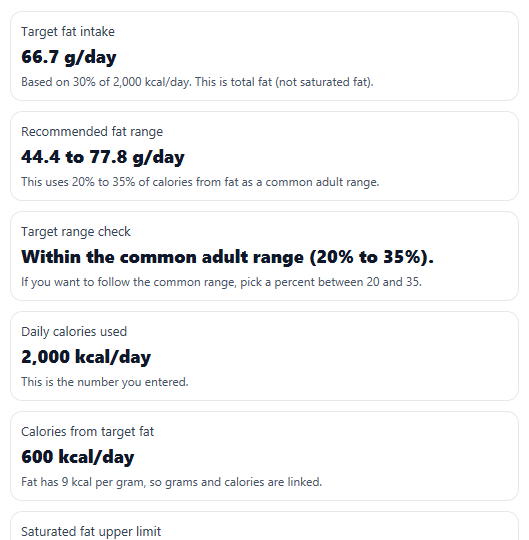
Target fat intake: Your main daily fat goal in grams, based on your calories and your chosen Target fat share of calories (%).
Recommended fat range: A suggested range of total fat in grams based on 20% to 35% of daily calories.
Saturated fat upper limit: The most saturated fat to aim not to go over in a day. It is shown as grams per day and should be treated as a cap, not a goal.
Daily calories used: The calorie amount the calculator actually used for all fat math. In estimate mode, this can include your Calorie goal adjustment (kcal/day).
Calories from target fat: How many calories come from your target fat grams.
Estimated resting calories (BMR): An estimate of how many calories your body uses at rest before activity is added.
Estimated maintenance calories: Your estimated daily calories after applying Activity level to BMR.
Target range check: A quick note showing whether your chosen fat percent is below, within, or above the standard adult range.
Common mistakes and quick fixes
Mistake: Entering one meal's calories in Daily calories (kcal/day) instead of your full daily total.
Fix: Use your total calories for the whole day, because all fat outputs are daily values.
Mistake: Leaving Target fat share of calories (%) blank or typing 0.
Fix: Enter a real percent greater than 0 and up to 100. Most adults who want standard guidance choose a value inside the Recommended fat range .
Mistake: Using estimate mode but entering height as feet and inches separately in Height (inches) .
Fix: Enter total height in inches. For example, 5 feet 6 inches should be entered as 66.
Mistake: Typing a maintenance calorie target into Daily calories (kcal/day) and also using Calorie goal adjustment (kcal/day) in direct mode.
Fix: In direct mode, the calculator uses Daily calories (kcal/day) only. The adjustment changes results only in estimate mode.
Mistake: Confusing Saturated fat upper limit with Target fat intake .
Fix: Treat Target fat intake as your total fat goal and Saturated fat upper limit as a cap to stay at or below, not a target to hit.
Mistake: Entering an extreme negative Calorie goal adjustment (kcal/day) that makes Daily calories used zero or negative.
Fix: Use a smaller deficit so the adjusted calorie level stays above 0.
Limitations & Key Assumptions / Boundary Conditions
- The recommended total fat range is based on a general adult range of 20% to 35% of calories, so it is a broad planning tool rather than a personalized medical target.
- The saturated fat result is shown as an upper limit using 10% of calories. Some heart-health advice is stricter, so personal guidance can differ.
- Estimate mode uses the adult Mifflin-St Jeor resting-energy equation, studied in healthy adults aged 19–78 [5]. Results for older adults are extrapolations. Activity multipliers are rough planning assumptions, not part of that study; actual calorie needs can differ. This tool does not assess whether a calorie deficit is appropriate.
- Height (inches) must be entered as total inches, not feet and inches in separate numbers.
- Calorie goal adjustment (kcal/day) affects results only in estimate mode. In direct mode, the calculator uses Daily calories (kcal/day) only.
- The calculator does not judge food quality, meal timing, protein, carbs, fiber, or medical conditions that may change a good fat target for you.
- If your chosen Target fat share of calories (%) is outside 20% to 35%, the calculator still computes the math but flags it as outside the standard adult range.
Methodology
How the calculator works
The calculator first decides which calorie value to use. In direct mode, it uses your entered Daily calories (kcal/day). In estimate mode, it estimates resting calories, multiplies by an activity factor to get maintenance calories, then adds your Calorie goal adjustment (kcal/day).
target fat grams = (daily calories used x target fat percent / 100) / 9
recommended fat range low = (daily calories used x 0.20) / 9
recommended fat range high = (daily calories used x 0.35) / 9
saturated fat upper limit = (daily calories used x 0.10) / 9
calories from target fat = target fat grams x 9
Estimate mode equations
When you choose calorie estimate mode, the calculator converts Weight (lb) to kilograms and Height (inches) to centimeters, then uses the Mifflin-St Jeor equation.
weight in kg = weight in lb x 0.45359237
height in cm = height in inches x 2.54
female BMR = 10 x weight kg + 6.25 x height cm - 5 x age - 161
male BMR = 10 x weight kg + 6.25 x height cm - 5 x age + 5
maintenance calories = BMR x activity factor
daily calories used = maintenance calories + goal adjustment
The activity factor is 1.2 for sedentary, 1.375 for lightly active, 1.55 for moderately active, 1.725 for very active, and 1.9 for extra active.
Worked mini-example
If your Daily calories (kcal/day) are 2,000 and your Target fat share of calories (%) is 30, then target fat is 66.7 g/day because 2,000 x 0.30 = 600 calories from fat, and 600 / 9 = 66.7 grams. The recommended range is 44.4 to 77.8 g/day, and the saturated fat upper limit is 22.2 g/day.
How to read the results
If your target percent falls inside 20% to 35%, your Target range check will show that it is within the standard adult range. A lower chosen percent gives fewer fat grams, and a higher chosen percent gives more fat grams, even when calories stay the same.
Assumptions used
This tool assumes 9 kcal per gram of fat and uses a general adult total-fat range of 20% to 35% of calories. The adult 20%–35% range comes from the National Academies [3]. The 10% saturated-fat limit follows the 2025–2030 Dietary Guidelines [4]; the AHA recommends less than 6%, so the displayed limit is not an AHA target [1]. Estimate mode is only an approximation because real calorie needs vary with body composition, health, and actual activity.