
Estimate your next period, likely ovulation, fertile window, and optional due date from the first day of your last period.
Advanced options
How to use our Period Calculator
- Enter the First day of last period, your Average cycle length (days), and your Average period length (days).
- Choose whether to turn on Also estimate due date if pregnant this cycle.
- Open Advanced options if you want a date range using Typical cycle variability (plus or minus days), a longer planning list with Future cycles to show, or a stronger caution note from Cycles are often irregular.
- Click Calculate to see the Next period start date, Likely ovulation date, Estimated fertile window, and other results.
- Sanity-check the results: if the Expected start date range is wide or the Timing note says timing is less predictable, use the dates as rough planning estimates instead of exact days.
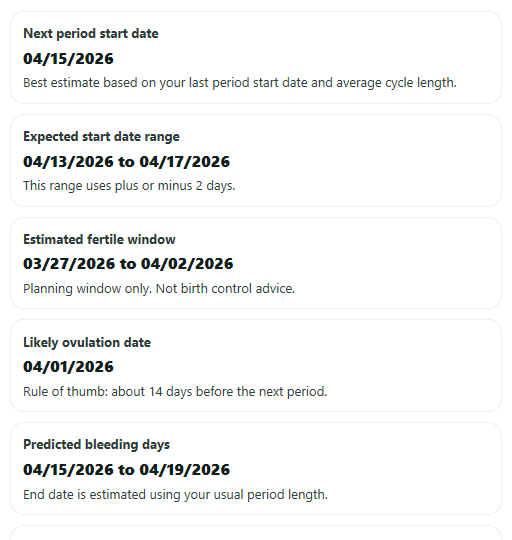
Definitions
First day of last period: The calendar date when bleeding started most recently.
Average cycle length (days): The usual number of days from the first day of one period to the first day of the next.
Average period length (days): The usual number of bleeding days in one period.
Next period start date: The calculator's best single-day estimate for when your next period may begin.
Expected start date range: An earlier-to-later window around the predicted next period date based on your entered variability.
Likely ovulation date: An estimate of when ovulation may happen, using the common rule of about 14 days before the next period [2].
Estimated fertile window: A planning window from 5 days before ovulation through 1 day after ovulation.
Estimated due date: If pregnancy happens this cycle, this is the due date estimated from the first day of your last period [1].
Timing note: A plain-language message that tells you how much confidence to place in the dates.
Common mistakes and quick fixes
Mistake: Entering the last day of bleeding for First day of last period .
Fix: Use the day bleeding started, because all date estimates count forward from that start date.
Mistake: Confusing Average cycle length (days) with Average period length (days) .
Fix: Enter cycle length as the days from the first day of one period to the first day of the next, and period length as how many bleeding days you usually have.
Mistake: Putting a value in Average period length (days) that is longer than Average cycle length (days) .
Fix: Make sure period length is at least 1 day and no more than your cycle length.
Mistake: Using 0 or a very large number for Typical cycle variability (plus or minus days) when you are guessing.
Fix: Leave it blank if you do not know, or enter the number of days your start date usually shifts by. The Expected start date range only appears when this input is valid.
Mistake: Reading Likely ovulation date or Estimated fertile window as exact biological timing.
Fix: Treat them as planning estimates. If Cycles are often irregular is yes, pay extra attention to the Timing note .
Mistake: Expecting Upcoming predicted cycles to be equally reliable far into the future.
Fix: Use later cycle dates for rough planning only. The farther out you go, the more real cycles can drift from the estimate.
Limitations & Key Assumptions / Boundary Conditions
- These results are estimates based on average dates, not direct hormone testing or ultrasound.
- The calculator assumes your Average cycle length (days) is a useful summary of your cycle. If your cycle changes a lot, the single predicted dates can be less reliable.
- Likely ovulation date uses a rule of thumb of about 14 days before the next period, so it can be off for many people, especially with irregular cycles.
- Estimated fertile window is for general planning only and should not be treated as exact timing.
- Expected start date range only reflects the Typical cycle variability (plus or minus days) you enter. It does not capture every cause of delay or early bleeding.
- Estimated due date uses last menstrual period dating and a cycle-length adjustment. Clinical dating can change after ultrasound [1].
- Upcoming predicted cycles become less certain the farther they are from your last real period start date.
- The calculator blocks clearly unrealistic input ranges, but valid-looking inputs can still produce poor estimates if your averages are not representative.
Methodology
How the calculator works
The calculator starts with the First day of last period and counts forward using your Average cycle length (days). It then estimates ovulation, the fertile window, bleeding days, and an optional due date using standard date arithmetic.
Formulas used
next_period_date = last_period_start + cycle_length
ovulation_date = next_period_date - 14
fertile_window_start = ovulation_date - 5
fertile_window_end = ovulation_date + 1
predicted_period_end = next_period_date + period_length - 1
due_date = last_period_start + 280 + (cycle_length - 28)
range_start = next_period_date - cycle_variability
range_end = next_period_date + cycle_variability
cycle_n_start = last_period_start + n x cycle_length
Worked mini-example
Suppose the first day of the last period was March 1, 2026, the average cycle length is 28 days, the average period length is 5 days, and typical variability is plus or minus 2 days.
next_period_date = March 1, 2026 + 28 days = March 29, 2026
ovulation_date = March 29, 2026 - 14 days = March 15, 2026
fertile_window = March 10, 2026 to March 16, 2026
predicted_period_end = March 29, 2026 + 5 - 1 = April 2, 2026
expected_start_date_range = March 27, 2026 to March 31, 2026
If due date is turned on for a 28-day cycle, the estimate is 280 days from the first day of the last period, which is a common LMP dating method [1].
How to interpret the results
Next period start date is the best single estimate. Expected start date range is usually more realistic if your cycle shifts by a few days. Likely ovulation date and Estimated fertile window are rough timing guides, not exact biological measurements. Upcoming predicted cycles are useful for planning, but each future cycle is less certain than the next one.
Assumptions behind the math
The due date estimate uses 280 days, or 40 weeks, from the first day of the last menstrual period, with a simple cycle-length adjustment from a 28-day reference cycle [1]. The ovulation estimate uses a rule of thumb of about 14 days before the next period [2]. The fertile window is estimated as 5 days before ovulation through 1 day after ovulation.
Practical limits
If your cycles are often irregular, if stress or illness recently changed your cycle, or if your averages are based on only a small number of months, the dates may be less precise. This calculator uses calendar date math correctly, but it cannot account for all real-world body changes.