
Enter the timing resistor and capacitor to calculate the nominal high-output pulse time for a standard 555 monostable timer.
Table of contents
How to use our 555 Monostable Timer Calculator
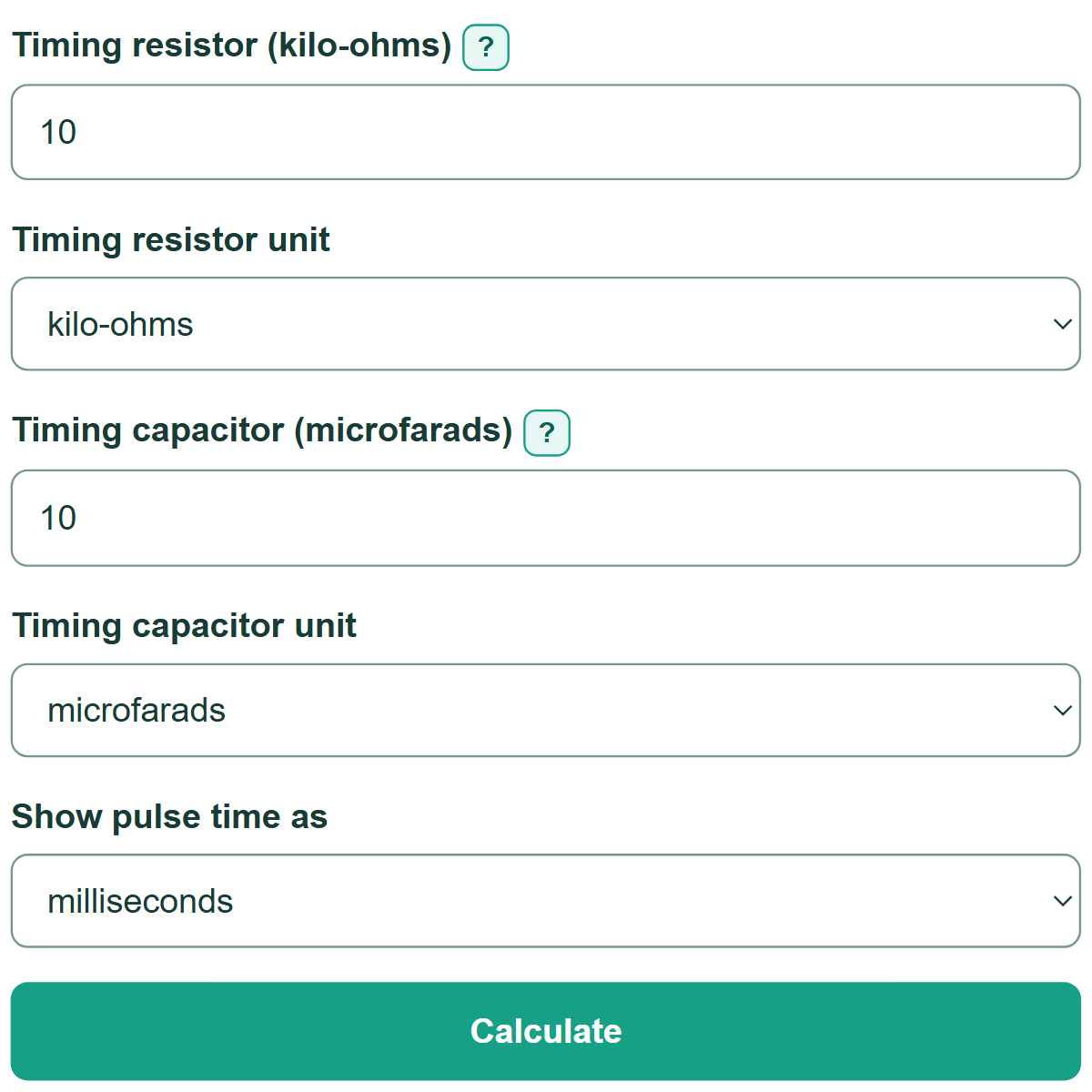
- Choose the unit printed on the timing resistor in "Timing resistor unit."
- Enter the resistor value in "Timing resistor."
- Choose the unit printed on the timing capacitor in "Timing capacitor unit," then enter its value in "Timing capacitor."
- Choose microseconds, milliseconds, or seconds in "Show pulse time as."
- Select "Calculate." "Nominal output pulse time" is the calculated time the output stays high after a valid trigger.
- For a new component, choose its unit before entering the number. If you change a unit after entering a correct value, the calculator converts the number to preserve the same physical resistance or capacitance.
Definitions
Monostable mode: A 555 timer setup that makes one output pulse after a trigger.
Timing resistor (R): The resistor that controls how quickly the timing capacitor charges.
Timing capacitor (C): The capacitor that charges during the output pulse.
Nominal pulse time: The ideal calculated pulse length from the component values before real circuit effects.
Microsecond (us): One millionth of a second.
Millisecond (ms): One thousandth of a second.
Common mistakes and quick fixes
Mistake: Choosing nanofarads for a capacitor marked 10 uF.
Fix: Match the selector to the marking. 10 uF equals 10,000 nF, so entering 10 with the wrong unit changes the calculated time by a factor of 1,000.
Mistake: Using a resistor that is not part of the timing path.
Fix: Use the resistor connected with the timing capacitor in the monostable circuit. Check the schematic or parts list if the circuit has several resistors.
Mistake: Treating the nominal result as an exact measured pulse length.
Fix: Measure the finished circuit if timing matters. Component tolerance, capacitor leakage, supply conditions, and the timer itself can change the pulse length.
Limitations & Key Assumptions / Boundary Conditions
- The result is a nominal value from the standard timing equation, not a guaranteed measured pulse length.
- Resistor and capacitor tolerance can change the pulse time. Capacitor leakage, temperature, supply voltage, trigger shape, wiring, and timer variation can also affect a real circuit.
- This calculation applies to the standard 555 monostable timing arrangement. Different connections or added components can change the behavior.
- Long timing intervals can be less dependable because capacitor leakage and other non-ideal effects have a larger effect.
Methodology
Timing calculation
The calculator converts resistance to ohms and capacitance to farads, then uses the standard nominal 555 monostable relationship. In the standard circuit, the timing interval ends when the capacitor rises near two-thirds of the supply voltage. [1]
t (pulse time in seconds) = 1.1 x R (resistance in ohms) x C (capacitance in farads)
The unrounded time is converted only for display using the unit selected in "Show pulse time as."
Worked example
With a 10 kilo-ohm resistor and a 10 microfarad capacitor, R is 10,000 ohms and C is 0.000010 farads.
t = 1.1 x 10,000 x 0.000010 = 0.11 seconds
The nominal output pulse time is 110 milliseconds.